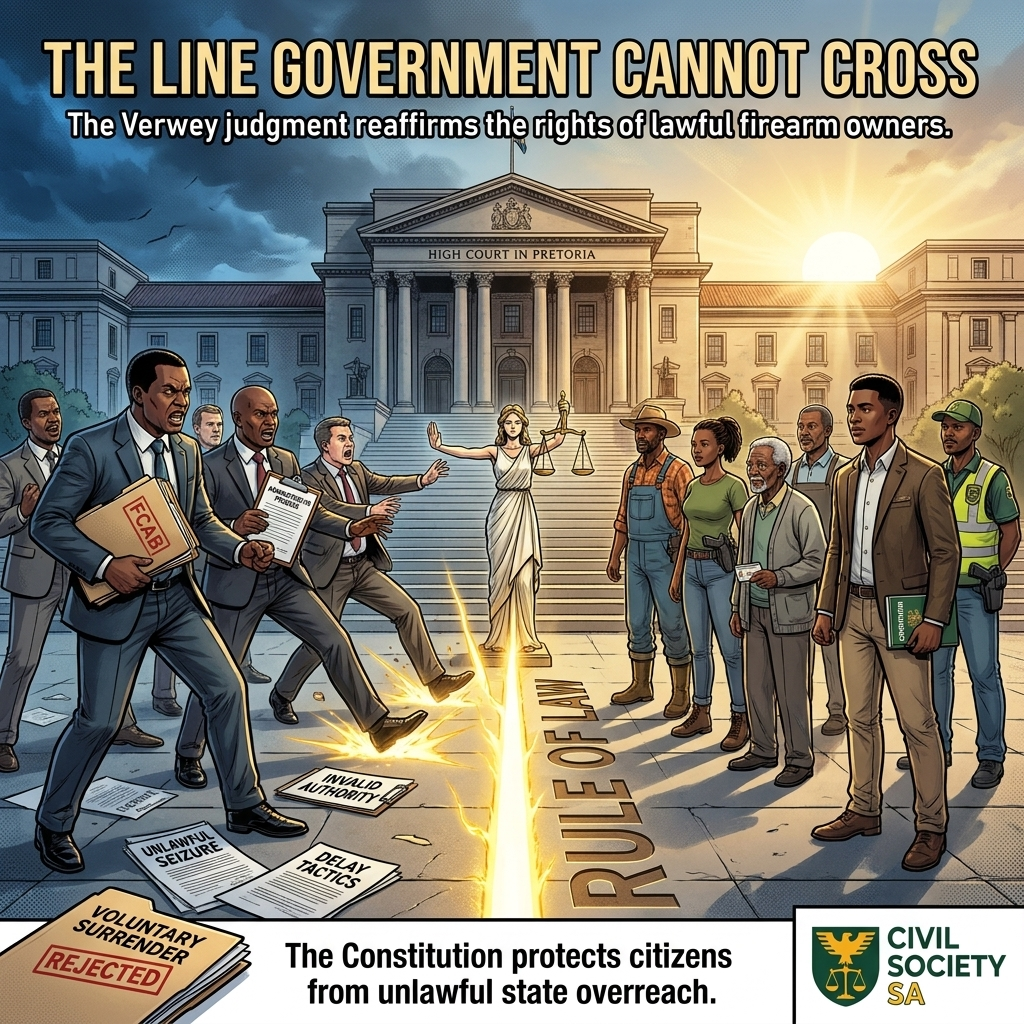
In the past few years, law-abiding South African firearm owners have found themselves under siege. The Department of Police and anti-gun groups have been persistent in their attempts to weaponise bureaucracy, public rhetoric and legislative tactics to disarm the South African population. This existential threat comes in the form of the controversial Firearms Control Amendment Bill (“FCAB”), a draconian piece of draft legislation designed to strip South African citizens of their right to possess firearms for self-defence. In our country where the state has openly signalled its desire to leave its citizens defenceless against rampant violent crime, the battle against the state’s agenda has now shifted to the courts. It is here where the defence against state overreach has been erected.
A recent, important judgement handed down in the High Court of South Africa, Gauteng Division, Pretoria, serves as an important victory for every firearm owner in our country. The case and judgement of Jacques Verwey v Minister of Police and Others (Case No. 2024-104069) written by Acting Judge K. Strydom, exposes the weak, unconstitutional strategies deployed by state officials to intimidate law-abiding citizens into surrendering their means of protection.
Importantly, the judgement establishes a powerful legal precedent that protects compliant firearm owners from administrative overreach, drawing a clear line in the sand that the South African Police Service (“SAPS”) cannot cross.
THE BACKGROUND
The facts in the Verwey matter perfectly illustrates the vulnerabilities that lawful firearms owners face on a daily basis in our country. Mr. Verwey completed his lawful firearm training through an accredited training facility in October 2020. His competency certificates were duly issues by the state in March 2021, and he subsequently obtained valid firearm licences for his three firearms. He complied with evert exhaustive, expensive and time-consuming facet of the Firearms Control Act No. 60 of 2000 (“FCA”). He did everything the law demanded of him.
However, during a subsequent criminal investigation into alleged irregularities at the accredited training facility where Mr. Verwey did his training, members of the Firearms Task Team targeted Mr. Verwey. On 27 August 2024, police officials visited Verwey and used their positions of authority to pressure him. According to Verwey, he was told in no uncertain terms that he could not retain possession of his firearms and has to hand them over to the Police Station. Out of fear and a desire to remain compliant, Verwey drove to the station, signed a “Property Acknowledgement of Receipt”, and surrendered his firearms and ammunition under the impression that he would have to redo his training and reapply for his licences.
When he later attempted to re-do the training and re-apply, the Designated Firearm Officer’s system revealed the ultimate truth: Verwey’s original competency certificates and licences were fully active, valid and unrevoked. The police had absolutely no legal basis to dispossess him.
THE STATES WEAK AND FLIMSY OPPOSITION
When Mr. Verwey launched an urgent application for the immediate return of his firearms, the state’s opposition was exposed as a masterclass in legal fragility and procedural stalling tactics. The Respondents offered a defence so thin that it was systematically dismantled by Acting Judge K. Strydom.
Firstly, the SAPS attempted a classic bureaucratic evasion tactic: they brough an application in limine to transfer the matter to the Easter Cape Division if Gqeberha, claiming lack of connection to the Pretoria High Court. They argued that because the criminal investigation was based in the Eastern Cape, the case belonged there. The Court saw right through this delay tactic, noting that the location of an independent criminal investigation against a third-party training provider was completely irrelevant to an urgent application brough by an innocent citizen. Verwey was neither a suspect nor an accused in that matter. His licences were valid, and the state could not hold his property hostage due to an unrelated, slow-moving criminal investigation against someone else.
Secondly, the state desperately argued that Verwey had handed over his firearms “voluntarily”, trying to use his compliance as an absolute defence against a spoliation claim (mandament van spolie). The state claimed that because he drove himself to the station and signed a form, no unlawful deprivation has taken place. The Court rejected this absurd notion with absolute contempt, reminding the police of the fundamental principle of legality. Acting Judge Strydom correctly held that police officers are public officials who exercise public power and can only act within the explicit boundaries of empowering legislation. The Court noted that “voluntary surrender” under the FCA refers to a permanent relinquishment of ownership for destruction, which was clearly not the case here.
Conversely, if the state wished to seize the weapons for an ongoing criminal case, they had to utilise Chapter 2 of the Criminal Procedure Act (“CPA”). Because the state explicitly denied that they have “seized” the weapons under the CPA, they were left stranded without a single statutory provision to justify receiving or retaining Verwey’s property. The state’s defence was so weak that their own council was forced to concede in open court that no statutory authority existed to empower the SAPS to retain the firearms under these circumstances.
THE LEGAL PRECEDENT
The importance of the Verwey judgement lies in its reaffirmation of core property rights and administrative law principles. It sets an invaluable precedent for legal firearm owners by reinforcing two critical legal doctrines:
“[13] It matters not that a government entity may be purporting to act under colour of a law, statutory or otherwise. The real issue is whether it is properly acting within the law. After all, the principle of legality requires of state organs always to act in terms of the law.” – High Court citing the Constitutional Court in Ngqukumba at paragraph 32.
By ruling in favour of Verwey on both the mandament van spolie (spoliation) and the rei vindicatio (owner’s right to reclaim property), the court establishes that the SAPS cannot use vague, ambient investigations as an excuse to disarm citizens. The judgement applied the foundational Oudekraal principle: an administrative action (such as granting of a firearm licence or competency certificate) remains valid, lawful and fully enforceable until it is formally set aside by a competent court of law. Speculations, “question marks” or pending investigations by the police do not diminish a citizen’s legal right to possess their firearms. Until a court revokes your licence, your possession is lawful, and any attempt by the police to pressure or trick you into surrendering your firearms constitutes unlawful deprivation.
WHY PARAGRAPH 19 IS A GAME-CHANGER FOR FIREARM OWNERS
In evaluating the state’s flimsy defence, Acting Judge Strydom included a critical observation that cuts straight to the heart of civilian firearm ownership in our country. Paragraph 19 of the judgement states:
“[19] The Applicant works in a high-risk industry (the selling and transporting of scrap metal including copper). He alleges that he requires the firearms for both his and his employees’ protection. The Respondents are of the view that this is insufficient to prove urgency and that the members of the SAPS have a sworn duty to protect the Applicant and will do so… In casu, I was satisfied that the Applicant had proven that the holding of firearms is essential to his and his employees’ protection within their industry.”
While brief, this single paragraph serves as an important victory and a power legal precedent for law-abiding firearm owners in our country. There are three crucial findings that can be found within this paragraph.
Firstly, it explodes the myth of “State Protection”. The Ministry of Police and anti-gun groups routinely push the narrative that citizens do not need firearms because the state is fully capable of protecting South Africans. In this very case, the state had the audacity to argue that the Applicant did not face an urgent need for his firearms because “members of the SAPS have a sworn duty to protect the Applicant and will do so.”
By formalising Paragraph 19, the High Court flatly rejected this detached-from-reality submission. The Judiciary legally recognised what ordinary citizens experience on a daily basis in our country: the state cannot be everywhere at once, and a private firearm is an indispensable lifesaving tool on the ground.
Secondly, it reaffirms self-defence as a non-negotiable priority. The primary objective of the FCAB is to remove sections of the FCA that allow for citizens to legally licence and own a firearm for self-defence reasons. Paragraph 19 flies directly in the face of this political agenda.
By explicitly linking Mr. Verwey’s volatile commercial trade to his need for protection, the court validated legal firearm ownership as a legitimate, necessary component of personal and workplace security. It firmly establishes that holding a firearm for protection is a rational and vital response to rampant violent crime.
Thirdly, it raises the legal bar for urgency. When the police unlawfully dispossess a firearm owner, they often try to delay court proceedings by treating it as a standard property dispute that can wait months, if not years, to be heard.
Paragraph 19 changes that for firearm owners seeking urgent relief. By framing the possession of firearms around the immediate protection of human life (both the owner’s and their employees’), the court recognises that arbitrary disarmament inflicts and immediate, life-threatening vulnerability. This gives compliant firearm owners a powerful precedent to demand immediate intervention from the courts whenever the state oversteps its bounds.
The bottom of the line is, paragraph 19 proves that the Judiciary recognises the reality of South African life, even if the Executive refuses to admit it. Your right to protect your life, your workers and your livelihood is recognised by the highest courts of the land and it remains non-negotiable.
CONCLUSION
The High Court ruling in the Verwey case stands in direct, irreconcilable conflict with the entire ideological foundation of the FCAB. The main objective of the FCAB is to strip citizens of their right to possess firearms for self-defence, driven by the state’s manufactured narrative the civilian firearm ownership is inherently harmful and that the SAPS is fully capable of safeguarding the country. By contrast, the High Court’s judgment anchored itself firmly in reality.
Through the inclusion of paragraph 19, the Judiciary legally validated what the Executive continues to deny: that private firearms are indispensable, lifesaving tools required for personal and workplace protection in a country fighting a violent crime crisis. The court’s rejection of the state’s argument that “police have a sworn duty to protect citizens” proves that the law recognises the state’s inability to provide real-time security, effectively neutralising the political propaganda used to justify the FCAB.
Ultimately, this case serves as a watershed moment and a blueprint for the future of civilian firearm rights in our country. It sends a clear message to the state that compliant, law-abiding firearm owners are not soft targets for administrative bullying or arbitrary disarmament. This case serves as a reminder to the architects of disarmament that lives, livelihoods and the fundamental right to self-defence are absolutely non-negotiable.
Stay Informed
Campaign updates, legislation alerts, and advocacy news. No spam.