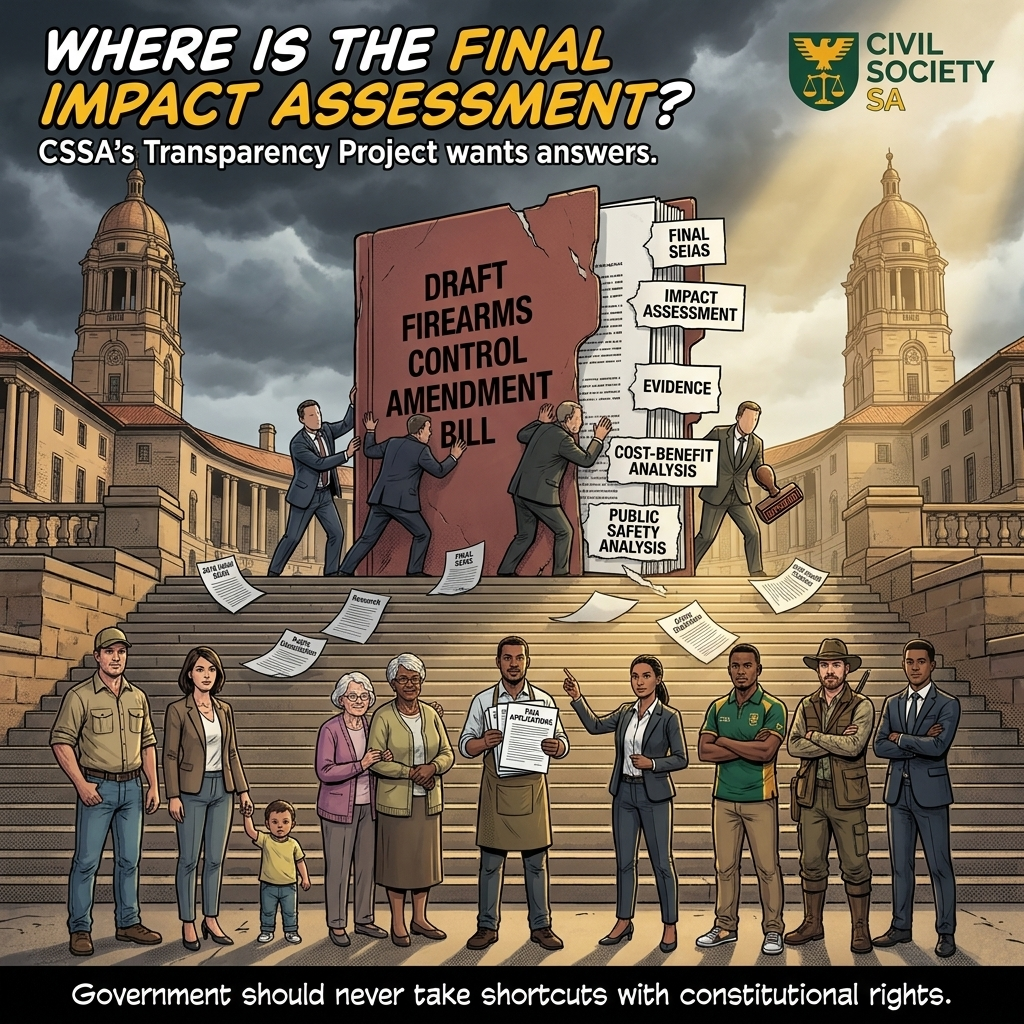
Civil Society South Africa (CSSA) has submitted the second set of Promotion of Access to Information Act (PAIA) applications as part of its Transparency Project, an ongoing initiative aimed at uncovering the evidence, research and decision-making processes behind the Draft Firearms Control Amendment Bill.
Last week, CSSA submitted the first application to the Civilian Secretariat for Police Service and the South African Police Service, seeking the policy documents, research, crime statistics, legal opinions, consultation records and other evidence relied upon in developing the proposed legislation. The latest applications shift the focus to the Socio-Economic Impact Assessment System (SEIAS), a key safeguard designed to evaluate the likely consequences of proposed legislation before it advances through the legislative process.
Read the previous Press Release here: https://civilsocietysouthafrica.co.za/cssa-launches-transparency-project-to-uncover-evidence-behind-proposed-firearm-law/
Today, PAIA applications were submitted to the Department of Planning, Monitoring and Evaluation (DPME) and The Presidency, the two institutions responsible for administering and overseeing SEIAS during different stages of the Bill’s development. Together, the applications seek the complete SEIAS record relating to the Draft Firearms Control Amendment Bill, including draft and final assessments, supporting research, internal reviews, recommendations, correspondence, meeting records, cost-benefit analyses, risk assessments and documentation indicating whether the Bill was permitted to proceed without a completed or satisfactory socio-economic impact assessment.
“The Transparency Project is deliberately following the paper trail,” says Reece Clark, National Spokesperson for Civil Society South Africa. “Every major legislative decision leaves a documentary record. We intend to find that record and place it before the South African public.”
SEIAS is intended to help government evaluate the likely social, economic and constitutional consequences of proposed legislation before it proceeds through the legislative process. Among other things, it is designed to assess whether a proposed policy is supported by evidence, whether less restrictive alternatives have been considered and whether the expected benefits outweigh the costs.
CSSA says the only publicly available SEIAS document it has identified is an Initial Impact Assessment prepared in 2016. The document itself states that its purpose is to ensure that policy-makers adequately analyse the problem, consider alternative approaches and avoid adopting inappropriate solutions before legislation is finalised.
“The obvious question is whether this initial assessment was ever followed by a final assessment and, if so, what it concluded,” says Clark.
“If further assessments were completed, they should be available. If concerns were raised during the SEIAS process, the public deserves to know what they were. Transparency is precisely why the SEIAS system exists.”
Among other records, CSSA is seeking documentation showing whether officials considered the Bill ready to proceed, whether revisions or additional evidence were requested, whether conditions were imposed before it advanced through the legislative process and whether those conditions were ultimately satisfied.
Clark says the proposed amendments make the requested records a matter of significant public interest.
“The Draft Firearms Control Amendment Bill proposes removing self-defence as a valid reason for firearm ownership. Before changes of that magnitude are made, South Africans are entitled to know whether the likely consequences were properly assessed and what evidence informed those conclusions.”
The Transparency Project will continue as CSSA submits further PAIA applications to the remaining government departments involved in developing the Draft Firearms Control Amendment Bill.
“Our objective has remained the same from the beginning,” Clark concludes. “We want South Africans to have access to the official record. Transparent government strengthens public confidence and leads to better law-making. That is what the Transparency Project is all about.”
Stay Informed
Campaign updates, legislation alerts, and advocacy news. No spam.