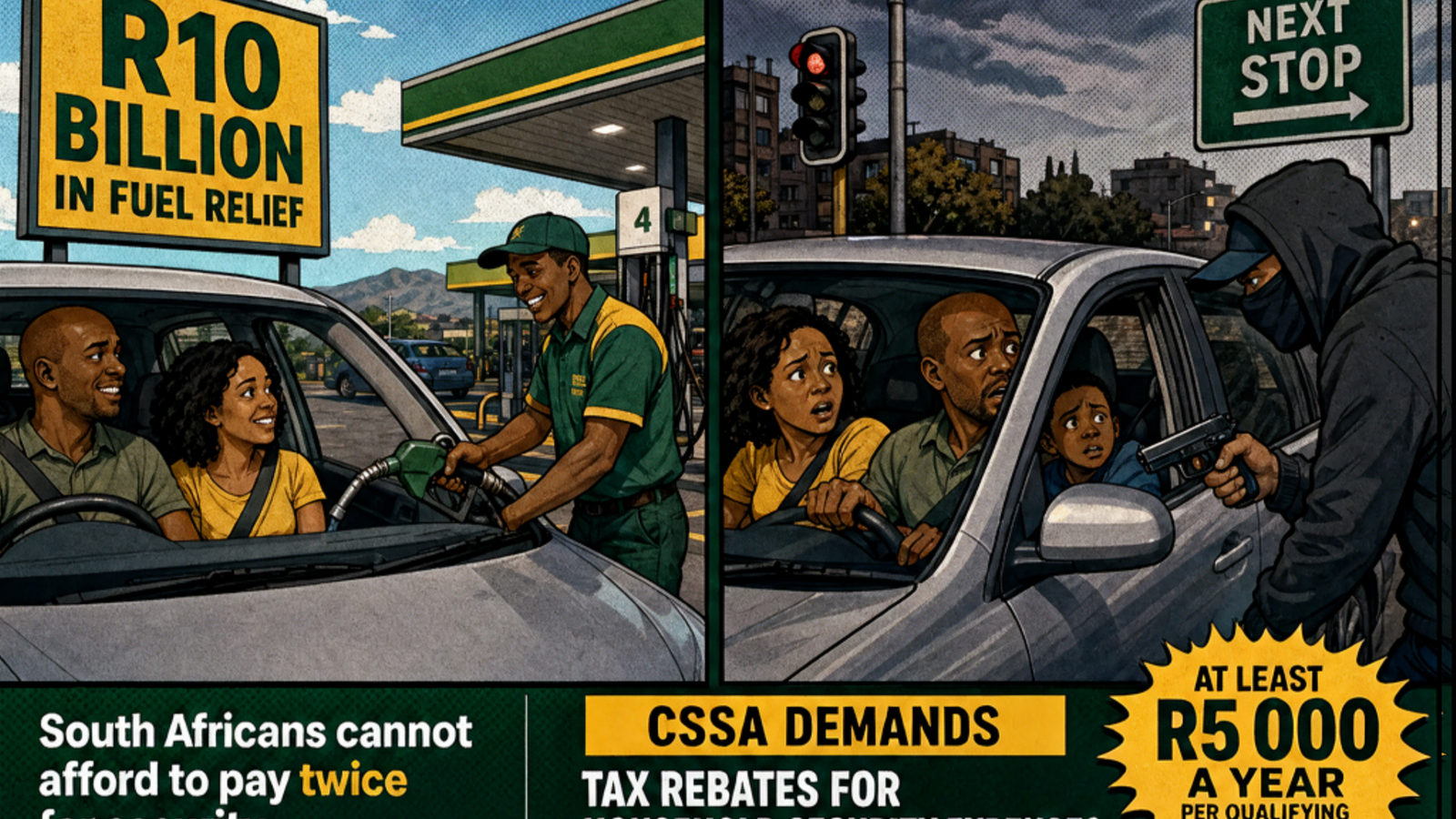
Civil Society South Africa (CSSA) is calling on Finance Minister Enoch Godongwana to include an annual household safety tax credit of at least R5 000 in the February 2027 National Budget, following today’s announcement of R10 billion in temporary fuel-levy relief.
CSSA welcomes the relief announced in the Medium-Term Budget Policy Statement but says government must also address the persistent financial burden on families paying for their own protection against violent crime.
“Fuel relief will help households under pressure. But when the fuel levy reduction ends, families will still have armed response subscriptions to pay and security systems to maintain,” says CSSA spokesperson Reece Clark.
“The Minister has recognised the need to cushion households against rising fuel costs. We are asking him to recognise the security bills that families carry month after month, while already paying taxes to fund policing.”
Through its Safety Tax Credits campaign, CSSA is proposing an annual tax credit of at least R5 000 per qualifying household for verified safety and security expenditure. For households receiving the full benefit, this would provide relief equivalent to approximately R417 a month.
Qualifying expenses could include armed response subscriptions, alarm systems, security gates, surveillance cameras, electric fencing and contributions towards community safety initiatives, subject to clear eligibility rules.
“For a family deciding which expenses to cut, cancelling armed response can mean accepting greater risk. Replacing a damaged security gate can mean postponing another essential purchase. These decisions have real consequences for household budgets and personal safety,” says Clark.
“South Africans are effectively paying twice for their safety: through their taxes and through the additional protection they have to fund themselves.”
CSSA is calling on National Treasury to evaluate the proposal ahead of the February 2027 National Budget and provide a formal response to its campaign. That evaluation should establish the qualifying expenses, eligibility criteria, fiscal cost and safeguards against fraudulent or duplicate claims.
The organisation also wants an appropriate support mechanism for households below the income-tax threshold, which would otherwise receive no benefit from a conventional income-tax credit.
“Families with little or no taxable income face serious security risks too. Treasury must consider how relief can reach them, including households that pool limited resources for community protection,” says Clark.
CSSA acknowledges that recurring tax relief requires careful costing. The R10 billion fuel intervention and an annual household safety credit have different fiscal implications. However, the organisation says the fuel announcement demonstrates that government can respond to exceptional household pressures through the tax system.
“Treasury should assess a defined proposal against verified expenditure and realistic eligibility criteria. We want a published assessment and a clear answer on whether government will recognise these costs in the next Budget,” says Clark.
CSSA stresses that household tax relief must accompany sustained improvements in policing, investigations and prosecutions. Government remains responsible for public safety, including the protection of people who cannot afford private security.
“Families need effective policing and relief from the financial burden they carry while trying to stay safe. A tax credit would recognise part of that burden. It would give government no excuse to retreat from its responsibilities,” says Clark.
“Minister Godongwana, give South Africans a clear answer before the February Budget: will you recognise the cost of protecting their families?”
CSSA encourages the public to support its Safety Tax Credits campaign at:
https://civilsocietysouthafrica.co.za/campaigns/safety-tax-credits/
Soundbite: https://civilsocietysouthafrica.co.za/wp-content/uploads/2026/10/R10-billion-in-fuel-relief-CSSA-calls-for-R5-000-safety-tax-credit-for-households.mp3
Stay Informed
Campaign updates, legislation alerts, and advocacy news. No spam.