South Africans will hear plenty of promises about fighting crime as political parties campaign for their votes. CSSA wants voters to ask those parties something more specific: will you oppose a law that prevents people from obtaining firearm licences for self-defence?
Some parties have already answered. Others still owe voters an explanation.
The proposed Firearms Control Amendment Bill (FCAB) brought this issue into sharp focus when the 2021 draft proposed repealing sections 13 and 14 of the Firearms Control Act. These sections provide for firearm licences for self-defence, including restricted firearms. The draft’s explanatory memorandum expressly stated that licences for self-defence would no longer be permitted.
Government has continued to pursue the legislation. In June 2026, Deputy Minister of Police Cassel Mathale said the FCAB was scheduled for introduction in Parliament during the financial year. The provisions of any revised Bill will need to be examined when it is introduced. Meanwhile, parties can tell the public whether they support keeping self-defence as a lawful reason for obtaining a firearm licence.
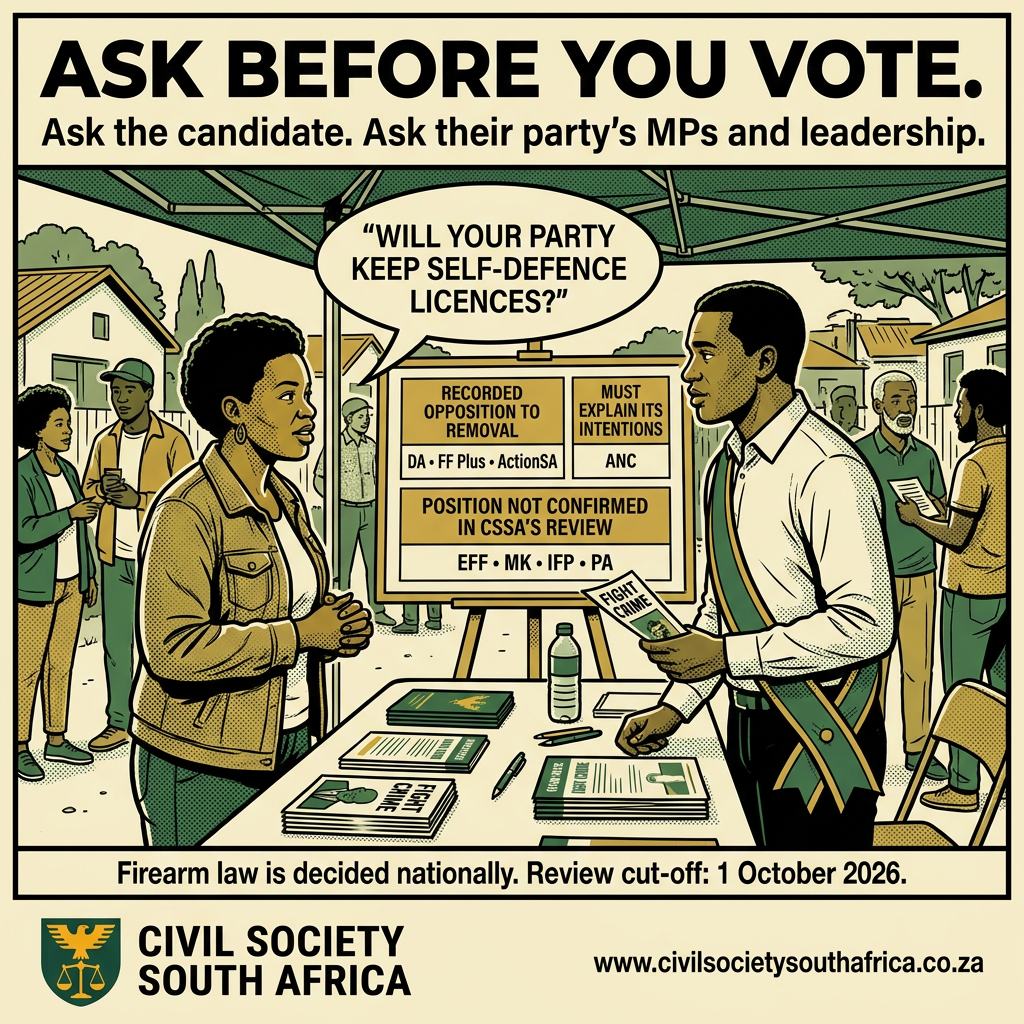
CSSA reviewed the public record of South Africa’s eight largest parliamentary parties. The DA, FF Plus and ActionSA have expressly opposed removing self-defence licensing. The ANC’s policy history and role in developing the proposal warrant scrutiny. The EFF supports strict gun ownership rules, but its position on abolishing self-defence licences remains unconfirmed. No explicit position on that provision was located for MK, the IFP or the Patriotic Alliance.
The ANC must account for the proposal
The proposal to remove self-defence licensing was published under an ANC government. It also sits within a longer party history: the ANC’s 1997 national conference resolutions identified a gun-free society as the ideal and called for a campaign to reduce the proliferation of weapons.
Those resolutions are nearly three decades old. They cannot tell voters exactly how the ANC will approach a revised Bill today. The government’s continued pursuit of the FCAB, however, gives the party ample reason to explain its intentions.
Does the ANC still support removing self-defence licences? Has it reconsidered the proposal? Will its MPs support retaining sections 13 and 14?
These questions concern a policy developed under its leadership. The ANC should answer them before asking voters to trust its plans for their safety.
The DA, FF Plus and ActionSA have opposed the change
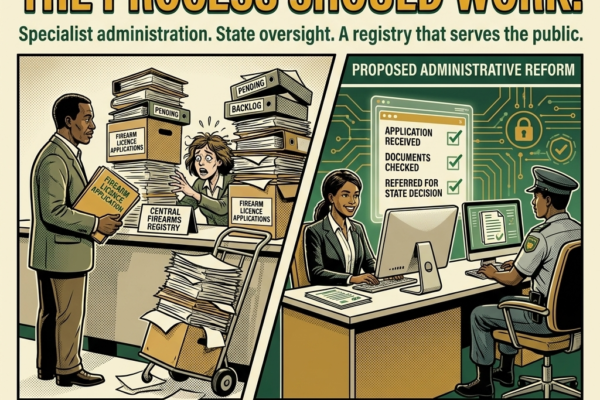
The DA has a clear public record against removing self-defence licensing. In May 2021, it committed to opposing the proposal when the Bill reached Parliament. In July 2026, DA Deputy Spokesperson on Police Ian Cameron called for the FCAB to be withdrawn and reconsidered in full. He argued that it undermines lawful self-defence and places further demands on an already struggling firearms administration system.
The July statement gives voters a recent commitment. They can expect the DA to oppose the removal of self-defence licensing and challenge it if its representatives depart from that position.
The FF Plus also opposed the proposal directly in May 2021, warning that removing the category would leave citizens vulnerable. Its 2024 manifesto subsequently committed to protecting competent citizens’ firearm ownership while addressing the illegal firearms trade.
ActionSA submitted objections to the draft in August 2021. Its campaign expressly opposed restricting firearm ownership for self-defence and criticised the proposed repeal of section 13. The party’s 2024 manifesto promised to make lawful firearm acquisition easier while strengthening sanctions for illegal possession.
All three parties have therefore given voters something concrete to work with. Their statements and policies support retaining access to firearms for lawful protection. Voters should follow what their MPs do when the legislation reaches Parliament, including the amendments they support and the votes they cast.
What would the EFF’s stricter rules mean?
The EFF’s 2024 manifesto promises strict rules on gun ownership and aggressive recovery of illegal firearms. It also proposes joint law enforcement operations to search for illegal weapons.
The manifesto does not establish whether the party would support repealing self-defence licensing. CSSA did not locate an explicit commitment resolving that question in the material reviewed.
The EFF needs to explain how its policy would affect someone applying legally for a firearm to protect themselves. Would that person still qualify? Would the party retain section 13? Which additional restrictions does it envisage?
Until those questions are answered, it would be inaccurate to describe the EFF as a confirmed supporter of the proposed repeal. It would be equally premature to assure voters that the party will oppose it.
MK, the IFP and the PA need to state their positions
MK’s published manifesto overview promises stronger border security and reform of law enforcement agencies. It does not say whether the party supports retaining firearm licences for self-defence. With 58 National Assembly seats, MK has considerable parliamentary influence, making its answer particularly relevant to the future of the legislation.
The IFP’s crime policies focus on police resources, community policing and accountability. It has also called for responsible firearm storage to prevent harm, particularly to children. These policies do not establish how it would approach the proposed removal of self-defence licences.
The Patriotic Alliance’s 2024 manifesto calls attention to police service firearms being lost and the need for accountability. Its position on retaining civilian firearm licences for self-defence was not established by the material reviewed.
CSSA cannot assign these parties a position without supporting evidence. Their supporters should ask them to make that position public.
A party’s promises about policing, border security or punishment do not answer whether it will allow a competent citizen to obtain a firearm for self-defence.
Ask before you vote
The FCAB concerns firearm licensing. Removing the self-defence categories would not, by itself, abolish lawful private defence under common law. It would close a legal route through which citizens can obtain firearms for protection.
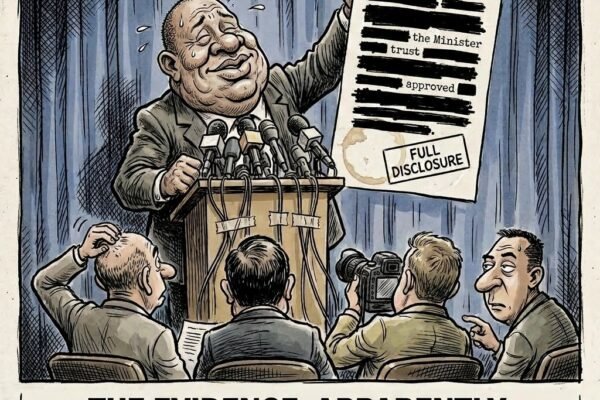
CSSA opposes that removal and is seeking the evidence government used to justify it. Through the Transparency Project, the organisation has filed PAIA applications for records covering the policy decisions, supporting research and socio-economic assessment behind the Bill, including its possible effects on lawful self-defence and public safety.
Parties should examine that evidence and explain their decisions to the people who will live with the consequences.
Municipal elections do not directly determine national firearm law, but candidates campaigning under a party’s banner can be asked about that party’s national policies. Voters can also direct the question to its MPs and leadership.
Ask them plainly: will you oppose removing self-defence as a lawful reason for a firearm licence?
The DA, FF Plus and ActionSA have recorded their opposition. The ANC must explain whether it intends to pursue the repeal proposed under its government. The EFF, MK, IFP and PA should give voters a clear commitment on the provision.
South Africans deciding whom to support deserve to know whether their party will preserve their ability to obtain a firearm legally to protect themselves and their families.
Research cut-off: 1 October 2026. This review covers the eight largest parties by National Assembly seats and reflects the public material located. Parties have not been contacted for comment. Where a position remains unconfirmed, this does not mean that the party has no position.
Stay Informed
Campaign updates, legislation alerts, and advocacy news. No spam.