South Africa’s violent crime crisis is often discussed in terms of numbers. Murders, rapes and aggravated assaults dominate public debate. Yet crime statistics tell only part of the story.
What ultimately determines whether crime decreases is not only how many offences are reported, but whether the justice system functions from beginning to end.
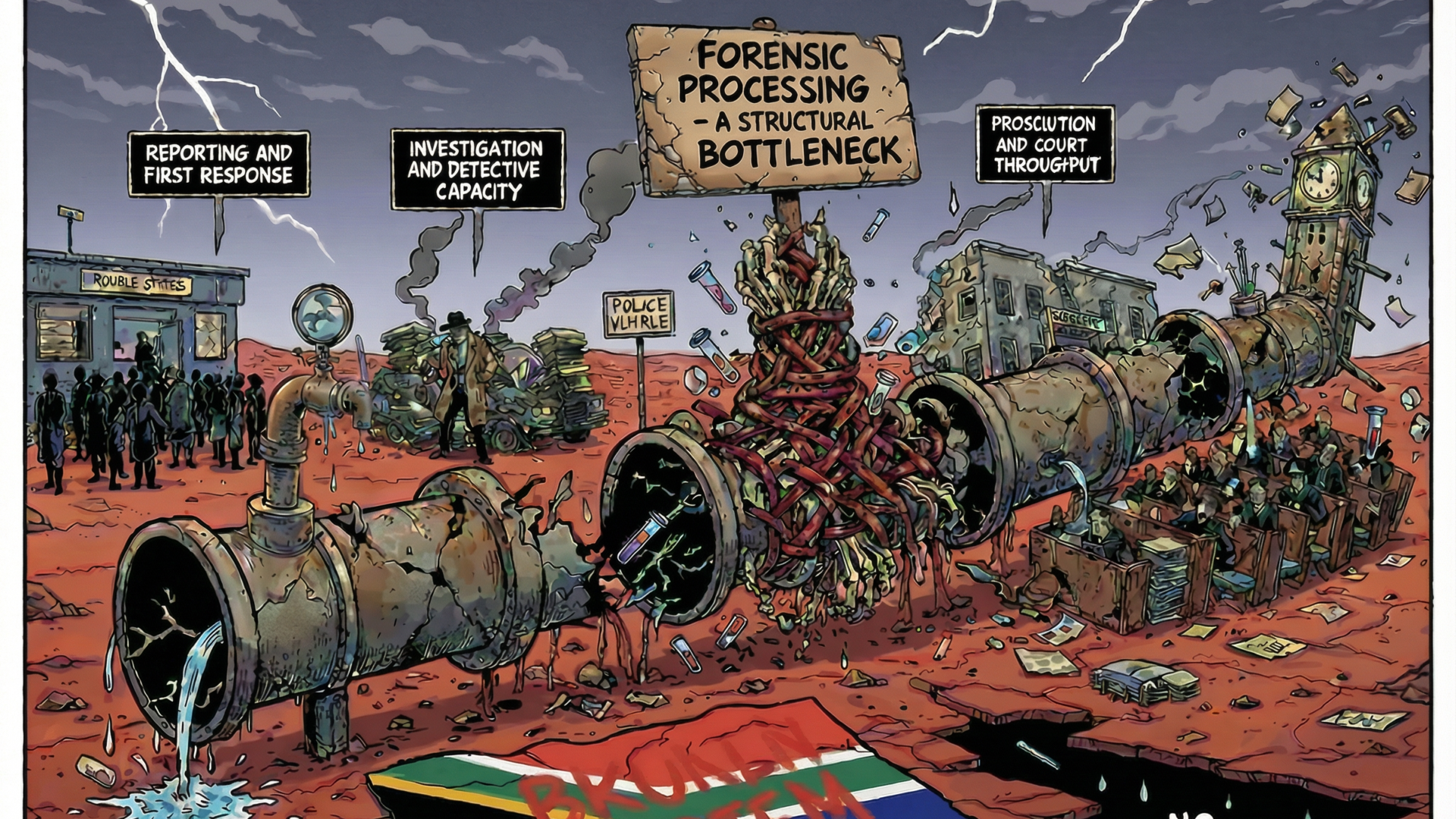
The criminal justice process operates as a pipeline. A case enters at reporting and exits at conviction and sentencing. If any stage fails, the entire system weakens.
Understanding where the pipeline breaks down is essential to restoring deterrence and public confidence.
Stage 1: Reporting and First Response
Every criminal case begins with reporting to the South African Police Service.
At this stage, two elements are critical: rapid response and proper initial documentation. In serious violent crime matters, early errors can permanently weaken a case.
Common breakdown points include:
- Delayed response times in high-burden areas.
- Incomplete or poorly recorded statements.
- Inadequate protection of crime scenes.
- Insufficient victim support in sexual offence cases.
The quality of the first 24 hours often determines whether a case remains viable months later. Where early steps are compromised, the likelihood of conviction decreases significantly.
Stage 2: Investigation and Detective Capacity
Once a case is opened, responsibility shifts to investigative units.
Detective services are central to the justice pipeline. They gather evidence, identify suspects, coordinate forensic requests and prepare dockets for prosecution.
However, in many high-incidence stations, detectives manage extremely high caseloads. Where one investigator is responsible for dozens of active violent crime matters, attention inevitably thins.
The consequences are predictable:
- Delays in arresting suspects.
- Incomplete evidence collection.
- Poorly prepared case dockets.
- Weak coordination with prosecutors.
Without sufficient investigative capacity, the pipeline begins to clog early.
Stage 3: Forensic Processing – A Structural Bottleneck
Forensic services are a decisive link, particularly in murder and sexual offence cases.
DNA analysis, ballistic testing and digital forensics frequently determine whether a prosecution succeeds. If laboratory turnaround times are prolonged or backlogs accumulate, cases stall.
Recent reporting highlights the scale of the forensic strain:
- The DNA backlog has been reported at over 140 000 outstanding samples, despite repeated commitments to stabilise capacity.
- Ballistic testing backlogs have exceeded 40 000 cases, many directly linked to violent crime investigations.
- In some reporting periods, forensic laboratories have failed to meet internal performance targets for turnaround times.
These are not abstract numbers. Each unprocessed DNA sample may represent a rape or murder case awaiting evidentiary confirmation. Each delayed ballistic report may affect a gang-related homicide prosecution.
Delays in forensic results have direct consequences:
- Bail hearings proceed without complete evidentiary records.
- Trials are postponed pending laboratory reports.
- Witnesses and victims experience prolonged uncertainty.
- Prosecutors may be forced to proceed on weaker evidentiary foundations.
Forensic inefficiency does not merely slow the system. It weakens its ability to deliver outcomes.
Stage 4: Prosecution and Court Throughput
Once an investigation is completed, the matter proceeds to court. At this stage, the integrity of the earlier steps is tested.
Breakdowns here include:
- Overloaded court rolls.
- Repeated postponements.
- Dockets returned for further investigation.
- Witness availability challenges.
- Administrative inefficiencies.
Judicial reporting in recent years has reflected ongoing pressure on court capacity, particularly in serious criminal matters. Case finalisation rates vary significantly between jurisdictions, and serious violent crime matters can take years to reach sentencing.
Where forensic delays intersect with court backlogs, postponements compound. A DNA report not finalised in time leads to a postponement. A postponed matter increases pressure on the roll. Extended timelines increase the risk of witness fatigue or relocation.
When serious violent crime cases take prolonged periods to conclude, the deterrent effect of sentencing diminishes. Justice that arrives years after the offence does not carry the same preventive weight as swift and certain consequence.
The justice system’s credibility depends not only on eventual conviction, but on timely and consistent adjudication.
The Missing Data: Conviction Rates and Case Completion Times
Public reporting focuses heavily on crime incidence. Far less transparent are outcome indicators:
- What percentage of murder cases result in conviction?
- What percentage of rape cases reach finalisation?
- How long does a serious violent crime case take from reporting to sentencing?
- How many cases are withdrawn due to evidentiary weakness or delay?
Without accessible, station-level and provincial conviction data, it is difficult to measure whether the justice pipeline is functioning effectively.
Incidence without outcome data obscures performance gaps.
The Compounding Effect
When breakdowns occur at multiple stages, the effect compounds.
A weak initial statement leads to a fragile investigation. A fragile investigation requires additional forensic evidence. Delayed forensic results prolong the court process. Extended timelines increase the risk of witness withdrawal or procedural error.
Each small failure amplifies the next.
By the time a case collapses, the cause may not be a single dramatic error, but cumulative inefficiency across the pipeline.
What Needs Fixing
Strengthening the justice pipeline requires coordinated reform rather than isolated interventions.
Civil Society South Africa identifies five priority areas:
- Stabilise and professionalise detective services in high-burden stations.
- Expand forensic laboratory capacity and publish turnaround metrics.
- Introduce stricter case management timelines for serious violent crimes.
- Improve data transparency on conviction rates and case duration.
- Strengthen inter-agency coordination between police and prosecuting authorities.
The goal is not merely to process cases faster, but to restore certainty of consequence.
Conclusion
Crime reduction depends on more than operational deployments or visible patrols. It depends on whether the justice pipeline functions from reporting through to sentencing.
Current forensic backlogs and court pressures illustrate that the system is under strain at multiple points. When those strains align, cases stall and deterrence weakens.
Repairing the justice pipeline requires disciplined management, transparent performance measurement and consequence for institutional failure.
South Africa’s violent crime challenge cannot be addressed by focusing on only one link in the chain. The system must function as a whole.
Stay Informed
Campaign updates, legislation alerts, and advocacy news. No spam.