The levels of violent crime in South Africa is not a new topic, and has been in the forefront of debate and argument since the Firearms Control Amendment Bill (“FCAB”) was introduced. In particular the FCAB seeks to remove self-defence as a valid reason for owning a firearm, for many South Africans this raises a potential constitutional question: does limiting access to lawful tools of self-defence undermine the rights the Constitution seeks to protect?
Civil Society South Africa strongly argues that it does. This article examines Section 11 and 12 of the Constitution coupled with a brief analysis of the common law principle of self-defence (private defence), we take a look at the preambles of both the Firearms Control Act (“FCA”) and the FCAB and the respective shift the FCAB seeks to achieve. The examination of the above, makes it clear that there are inherent risks of eroding core constitutional rights and protections by restricting self-defence mechanisms.
- Section 11 and 12 of the Constitution
The Constitution of our country is by far the most important legal document; it is a document that sets out the Fundamental Chapter 2 Bill of rights and the document which creates responsibilities on the state and private individuals. It sets the standard to which must be upheld by anyone in our country.
Section 11 of the Constitution states in clear simple terms “everyone has the right to life”. This was confirmed by the Constitutional Court in the Landmark judgement of S v Makwanyane. This judgment not only enforced a prohibition on the state taking life, but also imposes broader obligations on South Africans to respect and protect life in all circumstances.
Section 12(1)(c) of the Constitution goes further by stating “Everyone has the right to freedom and security of the person, which includes the right to be free from all forms of violence from either public or private sources”. The wording of this section is significant, it essentially doesn’t limit protection from violence to state actors alone, it explicitly includes private sources of violence, such as criminal attacks.
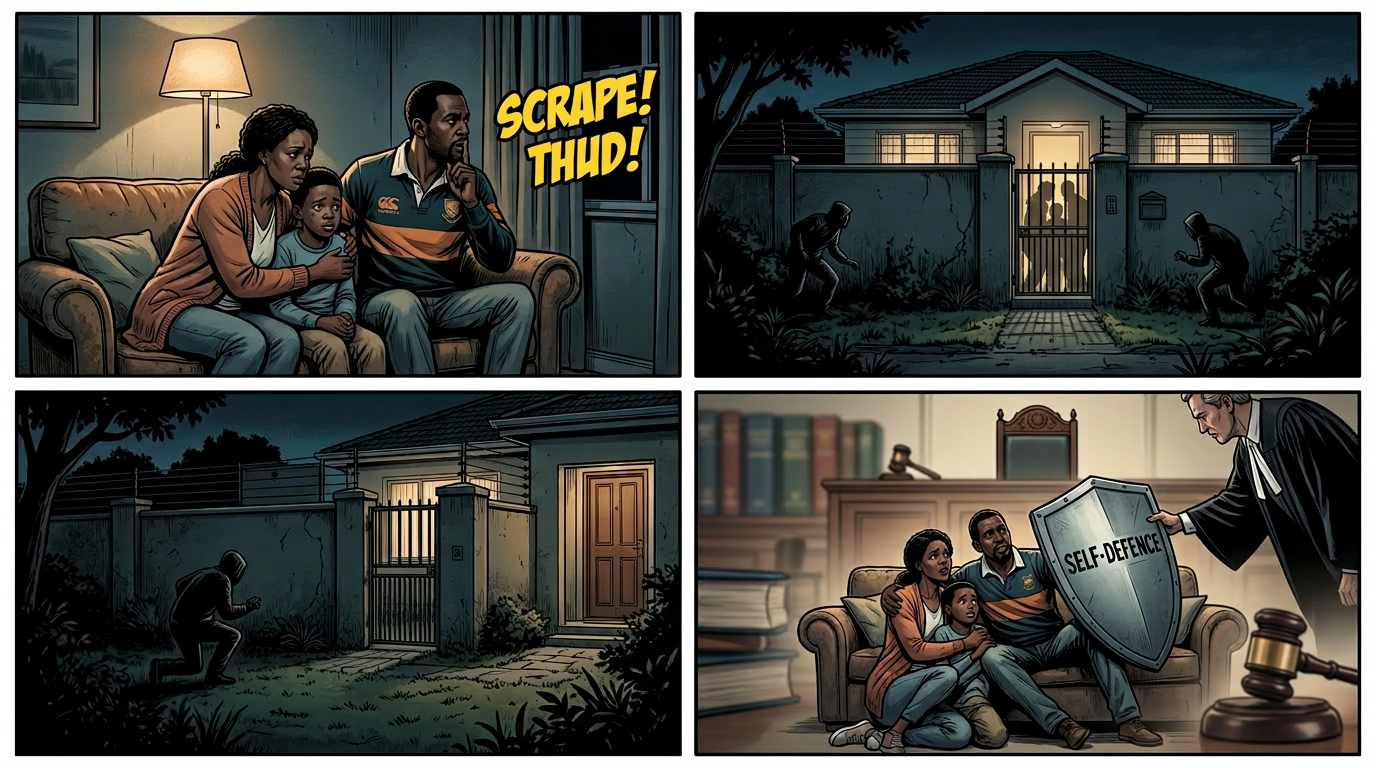
These provisions impose both negative and positive duties on the state. The state cannot violate these rights and must also take reasonable steps to protect individuals from violence. The reality in our country that citizens face on a daily basis, is the fact that the South African Police Service and the state are failing dismally in discharging their duties efficiently. When violent crimes occur in our country, citizens are forced to defend themselves in order to protect their constitutional rights to life and bodily integrity. This is where the common law principle of Self-Defence becomes of critical importance.
- The common law principle of self-defence (private defence)
At the outset, it should be made clear, this article is not an in-depth analysis on the requirements for self-defence to be successful in the court room, this article seeks to give clarity on whether self-defence is recognised in our legal system and in particular if there is any nexus between self-defence (private defence) and the constitutional rights discussed above. In this article, for ease of reference, we will use only the term self-defence, as it refers to an individual defending themselves against an unlawful attack.
A person acts in self-defence, and the act is therefore lawful, if [he or] she uses force to repel an unlawful attack which has commenced, or is imminently threatening, upon his or somebody else’s life, bodily integrity, property or other interest which deserves to be protected, provided the defensive act is necessary to protect the interest threatened, is directed against the attacker, and is reasonably proportionate to the attack. (Snyman, Criminal Law p103)
The above sets out the requirements that an accused must satisfy in order to successfully raise self-defence as a defence in criminal proceedings. Licensed firearms owners are more than aware of these requirements as knowing the law and when a firearm owner should use their firearm and should not use their firearm, form part of the current stringent legislation requirements they have to undergo to be a legal gun owner.
The Constitutional Court has recognised and affirmed the moral and legal legitimacy of self-defence. Chief Justice Chaskalson stated the following in his Judgement in S v Makwanyane (1995) at para 138:
“Self-defence is recognised by all legal systems. Where a choice has to be made between the lives of two or more people, the life of the innocent is given preference over the life of the aggressor… To deny the innocent person the right to act in self-defence would deny to that individual his or her right to life… Self-defence takes place at the time of the threat to the victim’s life, at the moment of the emergency which gave rise to the necessity and, traditionally, under circumstances in which no less-severe alternative is readily available to the potential victim.”
This recognition and affirmation was later confirmed in the case of Ex Parte Minister of Safety and Security and Others: In Re S v Walters and Another 2002 (7) BCLR 663 when the court made direct reference to the above. These two cases, along with many others, outline the stance the courts take with regards to the nexus that exists between the right to self-defence and the rights contained in Section 11 and 12 of the Constitution. Therefore, showing unequivocally that citizens have a right to defend themselves against violent crime, albeit citizens need to prove that their actions were in fact those of self-defence. This also confirms that self-defence is not merely a technical legal rule, it is directly connected to the right to life.
- The preambles and what they suggest
The preambles of the FCA and the FCAB are very different, and when one takes a closer look the intention of state becomes clear.
The preamble of the FCA states:
“WHEREAS every person has the right to life and the right to security of the person, which includes, among other things, the right to be free from all forms of violence from either public or private sources;
…
…
AND WHEREAS the Constitution places a duty on the State to respect, protect, promote and fulfil the rights in the Bill of Rights.”
As can be seen from the above, the Section 11 and 12 constitutional rights are explicitly mentioned and recognised, it further recognises the duty placed on the state to protect its citizens and to uphold the constitution, all while allowing the state to regulate and control firearms. It cannot be argued that there needs to be regulation and control over legally owned firearms. Responsible firearm ownership and accountability for legally owned firearms, is the backbone to having a stable society. However, these regulations, controls and mechanisms still need to be balanced against citizens rights, that balanced is currently achieved through the stringent regulations and legislative requirements the current FCA enforces.
In stark contrast to the preamble of the FCA, the FCAB provides the following:
”WHEREAS in terms of the Constitution of the Republic of South Africa, 1996, the duty to maintain public order, to protect and secure everyone in the Republic lies with the State;
AND WHEREAS the State is a signatory to regional and international instruments on control of firearms, ammunition and other related matters;
AND WHEREAS the State has an obligation to enact firearms legislation that complies with the applicable international and regional instruments;
AND WHEREAS the easy availability of firearms to civilians and their uncontrolled presence constitute major threats to the security of persons and property, sustainable development and the stability of the State;”.
From the outset the FCAB preamble makes no mention or recognition to the Section 11 and 12 constitutional rights, instead it shifts the duty to protect citizens solely into the hands of the state, whilst placing its authority to regulate firearms based on regional and international instruments. A concerning shift from the current FCA preamble. The intention is clear; the state does not want you to own a firearm to protect yourself in self-defence and they want full firearm control to be in the hands of the police and public safety institutions.
It is both unrealistic and unfeasible for the state to take sole responsibility for protecting its citizens, the reality is that the state has to date, failed to protect and keep its citizens safe. One just needs to look at the violent crime statistics, the unreliability of the South African Police service, shocking response times and criminal networks thriving under our government. All these factors point directly to the fact that the state cannot efficiently protect citizens, and by removing self-defence as reason to own a legal firearm (Section 13 amendment), most definitely has the potential to jeopardise and undermine the Constitutional and common law rights of South African citizens.
- Conclusion
South African law strongly protects the right to life and the right to be free from violence, as guaranteed by Sections 11 and 12 of the Constitution. Our courts have also confirmed that self-defence is a fundamental legal principle with close ties to these rights, the nexus between self-defence and constitutional rights can be seen to strongly exist.
Although gun ownership is a privilege and not a right, the common law principle of self-defence, as confirmed by our courts, recognises that citizens may lawfully protect themselves when faced with an unlawful attack. Legal gun ownership remains the most effective mechanism for citizens to protect their rights and enforce their rights to defend themselves. One could ask the question, If 160 government officials find the need to rely on heavily armed VIP protection to defend themselves against unlawful attacks, what makes their rights more important than the rights of ordinary citizen?
It is hard to find the rational behind removing self-defence as a reason to owning a firearm (proposed section 13 and 14 amendments in the FCAB), whilst still allowing firearms ownership and distribution for hunting and sport shooting. This essentially poses another question, does the state hold hunting and sport shooting in a higher light than the section 11 and 12 constitutional rights? Civil Society South Africa certainly argues that it does, and by removing self-defence it would appear on face value that the state will fall short of their constitutional obligations.
Civil Society South Africa strongly believes that there is a rights crisis looming from the FCAB. The rights of citizens and the realities of our country have not been taken into account meaningfully whilst the FCAB was drafted, and the true intention behind the FCAB will never be known. The age old saying rings true “Don’t bring a knife to a gun fight”.
Stay Informed
Campaign updates, legislation alerts, and advocacy news. No spam.