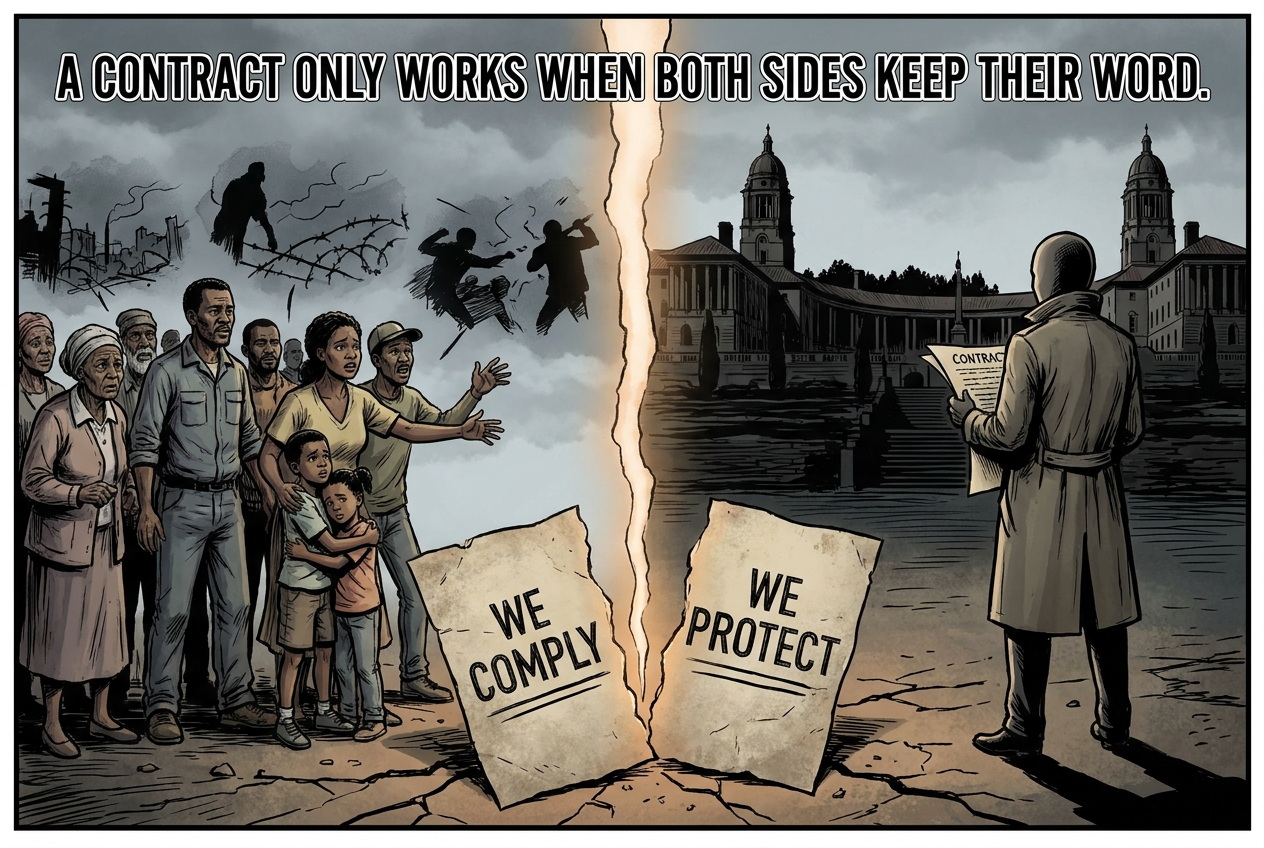
The social contract is a simple but powerful idea and lies at the heart of any functioning democracy. Citizens surrender certain freedoms and powers to the state in exchange for protection, order, and the safeguarding of fundamental rights. At present this social contract in South Africa is under severe strain.
The Firearms Control Amendment Bill (“FCAB”) cannot be considered in isolation. It must be judged within the full context of our country’s security crisis. This is not merely a piece of regulatory reform. It is a stark indictment of a deeper failure of governance. The state is increasingly incapable of performing its most fundamental duty, protecting its citizens, yet it now seeks to curtail those same citizens’ ability to protect themselves and their families.
At the heart of the social contract is the state’s duty to safeguard the lives and wellbeing of its citizens. This obligation is grounded in the Constitution of our country, which guarantees the right to life (Section 11) and the right to freedom and security of the person (Section 12). These rights are only meaningful if the state has the capacity to enforce them effectively. When enforcement of these rights is weakened or non-existent, the foundation of the social contract begins to erode.
A state struggling to provide security
It is a daily reality that our country continues to grapple with persistently high levels of violent crime, one just needs to look at the latest crime statistics published by the South African Police Service (“SAPS”), which depicts a country in trouble, with 71 murders being committed every day. Murder, armed robbery, rape and assault remain an entrenched feature in the daily life of South African citizens. It is the harsh reality that SAPS is under-resourced, overstretched and in many cases ineffective in preventing or responding to violent crime.
The scale of violent crime in our country has long exceeded the state’s policing capacity, forcing many communities and citizens to rely on private security or self-defence measures. The recent deployment of the Military in the Western Cape to aide SAPS and combat crime in the region, outlines and evidences this exact issue. Another factor which underscores a structural gap in public safety provision, is the ever-growing private security industry, which now outnumbers police personnel and has become an industry on which the state relies heavily to protect its citizens.
In this context, the social contract begins to fracture. When the state cannot guarantee safety, citizens become the first and only line of defence against violent crime, a dangerous vacuum which citizens are left to fill on their own.
The FCAB and disarming the law-abiding citizen
The most controversial aspect of the FCAB is the proposed Section 13 and Section 14 amendments, which seeks to remove self-defence as a lawful reason for firearm ownership. This proposed amendment strikes at the heart of the relationship between citizens and the state.
The FCAB effectively shifts the duty to protect citizens solely into the hands of the state, a striking difference from the preamble of the current Firearms Control Act, which explicitly cites the constitutional rights contained in Section 11 (right to life) and Section 12 (right to freedom and security of the person) of the constitution. It becomes clear, based on the realities faced in our country, that the state cannot effectively fulfil this proposed function, and ultimately removing self-defence as a valid reason for firearm ownership will place our citizens in a far worse off position then they are today. Quite frankly placing this duty solely on the state is shortsighted and unrealistic.
A troubling paradox is created in this instance. On one side, the state acknowledges, through crime statistics and policing challenges, that it cannot fully protect its citizens. Whilst on the other side, it proposes to remove a key means in which citizens can protect themselves and their families.
Such a contradiction does not strengthen the social contract. It becomes another nail in the proverbial coffin.
Policy assumption v the reality of crime
It is a well-known fact in our country that illegal firearms stem from illicit criminal networks, essentially criminals obtain these illegal firearms through theft, loss or corruption within state systems. In contrast, law abiding citizens, operate within a heavily regulated framework. Therefore, highlighting a fundamental misalignment between the policy assumptions and the realities of violent crime citizens face on a daily basis.
There is no doubt, that the FCAB is targeting the wrong problem. By focusing legislative energy in restricting compliant citizens rather than addressing illegal firearms and systemic policy failures, it becomes clear that the FCAB will fall short in achieving its primary purpose of protecting South African citizens. Illicit criminal networks will continue to grow and find more creative ways of obtaining illegal firearms, whilst South African citizens will be left with limited options to protect themselves and their families, with little to no help coming from the state.
The realities our farmers face in our country is another striking misalignment. The sad truth, is that farm attacks and farm murders have become a sad reality and a routine way of life, with farmers often being outnumbered when attacked and isolated from immediate help. Police response times in rural and farming areas are slow, often exceeding 60 minutes, with farmers themselves being the first and only line of defence against violent crimes. Farmers further must rely on community security structures for protection as a result of little to no support from the state.
The story of Pieter Andre Swart, a 37-year-old Free State farmer in the Kroonstad district, illustrates in a clear manner what our farmers endure in our country, and further depicts the necessity for self-defence. Mr Swart was surprised and ambushed on his farm by four suspects at the front door of his home, the four suspects attempted to overpower Mr Swart, during the altercation Mr Swart was stabbed in the neck and the head. Despite being wounded, Mr Swart managed to get to his legally licenced firearm and fire off several shots, these shots were fatal for three of the attackers with one attacker having fled the scene of the crime. Mr Swart was subsequently charged with three counts of murder, however, the court in this case confirmed that the facts supported self-defence after being stabbed during the attack.
In this context, it is clear that farmers have to rely on themselves and communities for protection from violent crime, and any limitation to access firearms for self-defence purposes, effectively strips farmers of their constitutional rights to protect themselves and their families lawfully.
This misalignment is not merely a policy failure. It is a breach of trust. Citizens expect the state to address the root causes of insecurity, not to impose additional constraints on those already abiding by the law.
Social contract theory in practise, a one-sided bargain.
Classical social contract theory, from Hobbes to Locke, rest on reciprocity. The state derives authority from its ability to provide security. When it fails to do so, its legitimacy is called into question. In our country, this imbalance is becoming increasingly evident. The state continues to demand compliance through licensing, regulation and now further restrictions, while failing to uphold their side of the bargain.
The FCAB amplifies this imbalance. It effectively is telling citizens “You may not defend yourself, but you must still rely on us.”
Yet, as the July 2021 riots demonstrated, there are moments when the state’s capacity collapses entirely. During this period, communities were left stranded with no other option than to arm and organise themselves to protect themselves and their communities from an ever-growing violent situation. This period illustrated that there is an absence of effective policing in our country.
Legislation that ignores these realities runs the risk of being not only ineffective, but detached from lived experiences.
Governance failures and eroding trust
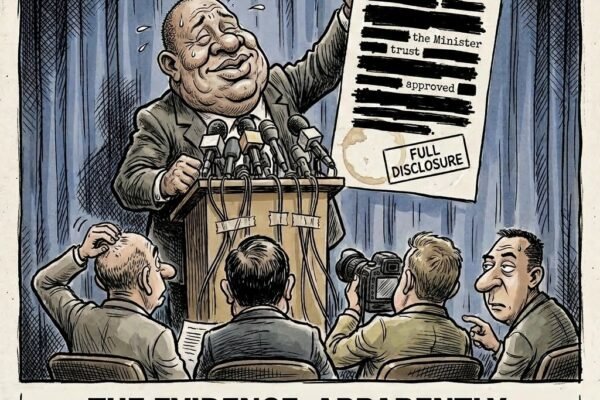
Beyond the substance of the FCAB, the process surrounding it has also drawn criticism. There have been concerns raised about the lack of transparency, insufficient consultation and the exclusion of key stake holders.
Trust is a cornerstone of the social contract. The mere perception that laws are being developed without meaningful engagement, or worse, in disregard of evidence, will result in the undermining of the legitimacy of those laws by citizens. Furthermore, allegations of corruption and mismanagement within state structures, including issues around firearms going missing from police stocks, has resulted in deeper public scepticism and has furthered the erosion of trust in the state.
The Madlanga Commission of Inquiry, which is currently in progress, outlines and demonstrates the exact reason why SAPS in our country has lost the trust of the public and gives the public a good understanding of just how deep the corruption networks go into SAPS and the state.
In such an environment, disarming citizens by removing self-defence is not a crime prevention strategy or measure, but rather it is an extension of a system already struggling with accountability.
A dangerous precedent
The most concerning aspect of the FCAB is the precedent it sets. If the state can restrict a citizens’ ability to protect themselves without first demonstrating its own capacity to provide protection, what does that say about the balance of power?
The social contract is not meant to be unilateral. It is not a system in which the state accumulates authority while shedding responsibility.
Yet that is precisely the trajectory this legislation suggests.
Conclusion
It is not simply a policy failure that our country faces, it faces a crisis of governance and trust. The FCAB in its current form, risks deepening that crisis. The proposal by the state, to remove self-defence as a legitimate basis for firearm ownership, will not strengthen public safety, it will unequivocally shift the responsibilities away from the state and constrain citizens who already operate within the law.
A credible way forward demands a complete reversal of the current approach. The state must rebuild the social contract by delivering effective policing, decisively targeting illegal firearm networks, confronting corruption head on and engaging citizens with genuine transparency.
Until the state can reliably fulfil its most basic duty, the protection of its people, any effort to restrict citizens’ ability to defend themselves will not be viewed as reform, but as a deepening of existing failure.
Civil Society South Africa strongly believes that a social contract built on failure, will not and never will endure.
Stay Informed
Campaign updates, legislation alerts, and advocacy news. No spam.