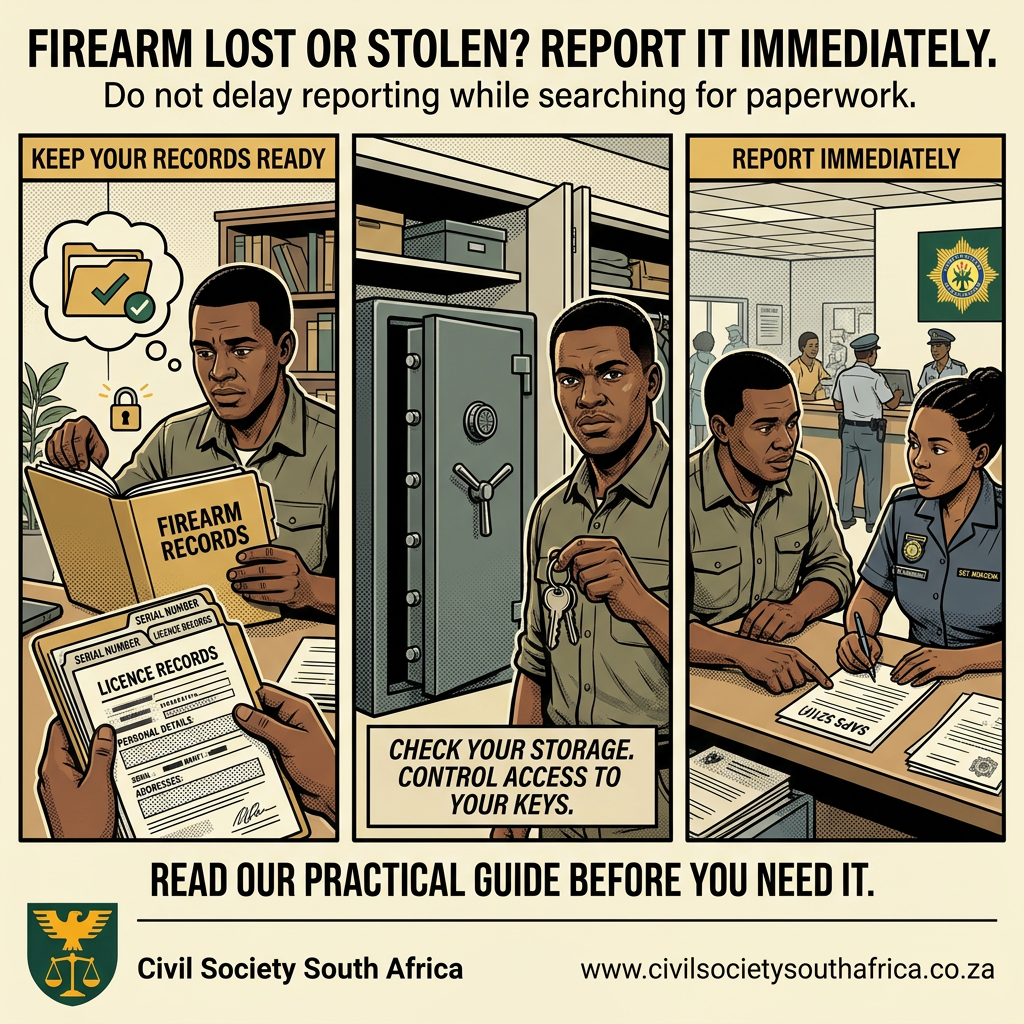
As a firearm owner in South Africa, responsible firearm ownership extends far beyond range safety and tactical handling. The legal framework defined by the Firearms Control Act 60 of 2000 (“FCA”) places a stringent duty of care on every licence holder. When a firearm goes missing or is stolen, panic often sets in, but knowing the precise procedure to follow is vital to protecting yourself, maintaining your legal status, and assisting law enforcement.
THE 24-HOUR REPORTING WINDOW
The moment you discover that your firearm is missing or the moment your firearm has been stolen, a statutory timer begins. Under Section 120(11) of the FCA, you are legally obligated to report the loss or theft of any firearm to the police within 24 hours of discovering the incident. Failing to meet this timeframe constitutes a distinct criminal offence in itself, regardless of how or why the firearm was taken.
You must physically go to the nearest South African Police Service (“SAPS”) station to file the report. While it is advisable to visit the police station covering the jurisdiction where the incident took place, any SAPS station must accept your initial report and open the case before transferring it if necessary.
WHAT TO DO AND WHO TO SPEAK TO AT THE POLICE STATION
When arriving at the station, present yourself directly to the officers at the front desk and request to report a stolen or lost firearm. You will need to speak with two key officials: the investigating officer assigned to open your docket and the station’s Designated Firearms Officer (“DFO”).
You must bring your official South African identity document and a copy of the original firearm licence, card, or competency certificate, it is advised to bring all relevant documentation that you have for the specific firearm that has been stolen or lost. You will be required to complete the official SAPS 521(f) form, which is the Notification of Lost, Stolen, or Found Firearms. Provide the exact details of the firearm, including the make, model, calibre, and barrel or frame serial numbers. You will also need to make a detailed written statement under oath explaining the exact circumstances surrounding the disappearance.
Ensure you leave the station with a CAS (Crime Administration System) number, a stamped copy of your SAPS 521(f) form, and written acknowledgement of your statement. The DFO will capture these details onto the Central Firearms Registry (“CFR”), which flags the serial numbers across national police databases.
UNDERSTANDING YOUR LEGAL LIABILITY AND CONSEQUENCES
Filing the SAPS 521(f) triggers a dual process. While the police investigate the theft or loss as a crime, they simultaneously open an inquiry into whether you, as the licence holder, acted negligently.
Under Section 102 of the FCA, the Registrar of Firearms may declare a person unfit to possess a firearm if they have lost a firearm through negligence or failed to lock the firearm away properly. If declared unfit, all existing licences you hold are automatically revoked, you must surrender all remaining firearms and ammunition, and you will typically be barred from owning firearms for up to five years. Furthermore, if a criminal or civil court finds that your gross negligence directly enabled a criminal to use your firearm in a subsequent violent crime, you could face common-law civil claims for damages or criminal prosecution as an accessory.
THE FALLOUT OF SAFE STORAGE NON-COMPLIANCE
South African law strictly mandates that whenever a firearm is not under your direct physical control, it must be locked inside an approved safe or strongroom that complies with SANS (SABS) 953-1 or 953-2 standards. Handgun safes must feature minimum steel thickness requirements and be anchored into a solid brick wall or concrete floor using heavy-duty masonry bolts.
If the police investigation reveals that your firearm was stolen because you failed to follow safe storage compliance, such as leaving your firearm in your vehicles cubbyhole, inside or on top of your night stand, under your mattress, or in an unanchored safe, you will face criminal charges under Section 120(8) of the FCA for failure to lock a firearm in a prescribed safe.
A conviction for safe storage non-compliance carrier penalties including substantial criminal fines and potential imprisonment. Beyond statutory fines, a failure to meet safe storage requirements automatically leads to an unfitness declaration, permanent criminal record, and the total forfeiture of your firearm collection. Additionally, insurance policies covering your firearm or property will almost certainly repudiate any claims if there is evidence of structural non-compliance with safe storage laws. Ensuring your safe is properly bolted down and keeping keys under your exclusive physical control remains your primary line of defence against both criminals and severe legal prosecution.
CONCLUSION
Losing a firearm is a crisis, but remaining transparent, decisive, and fully compliant with the reporting process is the single best path forward. Firearm ownership in South Africa is a privilege coupled with uncompromising responsibility, and adhering to strict safe storage practices remains your ultimate legal shield. By reporting an incident immediately, cooperating thoroughly with the SAPS, and maintaining proper statutory storage, you fulfil your civic and legal obligation to keep your community safe while safeguarding your rights as a licence holder.
Stay Informed
Campaign updates, legislation alerts, and advocacy news. No spam.